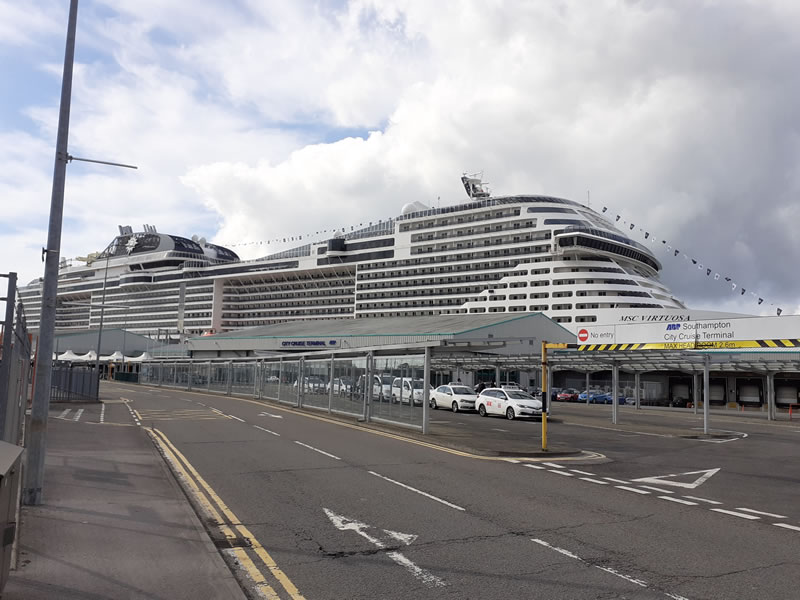
If you are travelling to Southampton Cruise Port for a cruise, one of the most important questions to answer is: how early should you arrive at Southampton Cruise Terminal?
The safest approach is to follow the arrival or check-in time provided by your cruise line. As a general planning rule, allow enough time to complete luggage drop-off, security, check-in and boarding without rushing. If you are travelling from London, Heathrow, Gatwick or another location on the same day, allow additional time for the journey and possible delays.
Your ship's scheduled departure time is not necessarily your recommended terminal arrival time. Cruise lines may use assigned arrival windows and final check-in or boarding deadlines, so always check your cruise documents before travelling.
If you are travelling with family, several pieces of luggage, or from London on cruise day, building in extra time can make the start of your cruise much less stressful.
Southampton is one of the busiest cruise ports in the
UK, handling thousands of passengers daily. Arriving at the right time is
essential to avoid long queues, manage luggage
efficiently, and enjoy a relaxed boarding experience. In this
guide, we’ll cover ideal arrival times, what to expect at
the cruise terminal, and helpful tips for a smooth start to your cruise.
Plan to arrive within the arrival or check-in window provided by your cruise line. If no specific time is given, allowing a generous buffer before the ship's scheduled departure is sensible, particularly when travelling from London or an airport.
The time you need depends on:
For first-time cruisers, it is generally better to have extra time than to arrive close to the final boarding deadline.
Cruise ships operate according to strict schedules. Unlike a taxi or train, a cruise ship cannot normally wait for individual passengers who arrive late.
Arriving at the correct time gives you enough opportunity to:
At the same time, arriving significantly earlier than your assigned arrival window may simply mean waiting for the terminal process to begin. The goal is therefore not necessarily to arrive as early as possible. The goal is to arrive at the right time with enough travel buffer.
Pre-booking a Southampton Cruise Port Transfer can make this
journey even smoother, especially if you’re travelling from London or another
city.
Cruise ships operate according to strict schedules. Unlike a taxi or train, a cruise ship cannot normally wait for individual passengers who arrive late.
Arriving at the correct time gives you enough opportunity to:
At the same time, arriving significantly earlier than your assigned arrival window may simply mean waiting for the terminal process to begin.
The goal is therefore not necessarily to arrive as early as possible. The goal is to arrive at the right time with enough travel buffer.
Most cruise lines suggest passengers arrive
at the terminal 2–3 hours before the scheduled departure. This
timing balances sufficient preparation with avoiding unnecessary waiting.
Here’s a general guideline:
|
Stage |
Recommended Timing |
|
Terminal Arrival |
2–3 hours before departure |
|
Check-In & Documentation |
30–60 minutes |
|
Security Screening |
15–30 minutes |
|
Boarding |
Usually 1–1.5 hours before departure |
Following these timings ensures you have ample time for
all procedures without rushing.
This is an important distinction for cruise passengers. Your cruise's departure time is when the ship is scheduled to leave Southampton. Your check-in or arrival time is when the cruise line expects you to arrive at the terminal.
These are not always the same.
For example, a passenger whose ship departs in the afternoon should not automatically assume that arriving shortly before departure is acceptable. There may be a final check-in or boarding deadline before the ship leaves.
Always check:
If you are travelling independently to Southampton, plan your journey around the required terminal arrival time, rather than simply working backwards from the ship's departure time.
The exact process can vary by cruise line and terminal, but your cruise-day journey will generally involve several stages.
Southampton has several cruise terminals, so make sure you know which terminal your ship is using before leaving for the port.
Do not simply enter "Southampton Cruise Terminal" into your travel plans without checking the terminal shown on your cruise information.
If you have luggage that will be delivered to your cabin, follow the terminal's luggage-drop instructions.
Keep important items with you in your carry-on bag, including:
Your checked luggage may not reach your cabin immediately after boarding.
Passengers normally need to go through security before entering the boarding area.
Keep your documents and required items easily accessible to make the process easier.
Your cruise line may require verification of:
If you completed online check-in before arriving, the terminal process may be simpler, but you should still have your required documents available.
Depending on the cruise line and terminal operation, passengers may board according to assigned groups, arrival windows or other procedures.
Once your group is called, your documents or cruise card will be checked before you board the ship.
If this is your first cruise, give yourself more time rather than trying to arrive close to the deadline.
First-time passengers may need additional time to:
You don't need to arrive unnecessarily early, but having a comfortable buffer can make the experience considerably easier.
If you are staying in London and travelling to Southampton on the same day as your cruise, don't plan your journey around the ship's departure time alone.
Instead, work backwards: Cruise check-in requirement → Southampton Cruise Terminal arrival → London departure
This allows you to account for:
For passengers with several bags or families travelling together, a direct private transfer can be particularly convenient.
There is no single departure time that works for every cruise passenger because your required arrival time depends on your cruise line and assigned check-in window.
A better approach is to calculate your journey backwards from the required terminal arrival time.
For example:
Required terminal arrival time
↓
Add a buffer for traffic or delays
↓
Allow time for luggage and hotel departure
↓
Calculate your London pickup time
This is especially important when travelling on the same day as your cruise.
A London to Southampton Cruise Port Transfer can provide a direct journey from your hotel, home or another London pickup location to the cruise terminal.
Passengers arriving at Heathrow Airport on cruise day should allow time for:
If your flight arrives on the same day as your cruise, avoid scheduling your airport arrival so close to the cruise check-in deadline that a small flight delay could disrupt your plans.
For international passengers, travelling to Southampton the day before the cruise can provide an additional safety margin.
The same principle applies when travelling from Gatwick Airport to Southampton.
Allow time for:
If you are travelling directly from Gatwick to Southampton Cruise Port, a pre-booked transfer can simplify the journey, particularly when travelling with multiple bags.
No. Southampton Central is a railway station, not the cruise terminal. This is an important point for passengers travelling by train.
A typical rail journey may be: London Waterloo → Southampton Central → onward transfer → cruise terminal
The final leg from Southampton Central to your assigned cruise terminal still needs to be arranged.
Passengers with light luggage may find the train convenient, while passengers with large amounts of luggage, families or tight cruise-day schedules may prefer a direct private transfer.
Your best transport option depends on your priorities.
| Factor | Train | Private Transfer |
|---|---|---|
| Cost | Generally lower | Generally higher |
| Luggage | Self-managed | Easier |
| Route | Station-to-station | Door-to-terminal |
| Changes | Onward transport required from Southampton Central | No train change |
| Families | Can be less convenient with luggage | Convenient |
| Groups | Depends on luggage | Often practical |
| Traffic | Less affected by road traffic | Road traffic can affect journey |
A private transfer is particularly useful when your priority is a direct door-to-terminal journey.
Arriving extremely early is not always better. Your cruise line may operate specific arrival or check-in windows, and you may have to wait if you arrive before your allocated time.
For this reason, check your cruise documents before leaving.
The ideal strategy is: Follow your assigned arrival time + allow enough travel buffer.
Arriving late is considerably more problematic. If you arrive after your cruise line's final check-in or boarding deadline, you may not be allowed to board.
Cruise ships follow strict departure schedules, so passengers should not assume that the ship will wait for them.
If you are travelling to Southampton on cruise day, allow additional time for unexpected problems such as:
For passengers travelling a long distance to Southampton, staying the night before the cruise locally can reduce cruise-day travel risk.
This can be particularly useful if you are travelling from:
Staying near Southampton means you can travel to the terminal on the morning of your cruise rather than depending on a long journey on embarkation day.
For passengers travelling from London who have a comfortable schedule and reliable transport, travelling on the same day can also be practical.
Before leaving for the port, check the following:
Don't rely only on the ship's departure time. Check your assigned arrival or check-in window.
Start with the required terminal arrival time and work backwards to determine when you need to leave.
Traffic, rail delays and airport delays can affect your journey.
Southampton has multiple cruise terminals. Confirm your assigned terminal before travelling.
Don't put passports, medication, valuables or essential travel documents into checked luggage.
If your cruise line offers online check-in, completing it before travelling can make your terminal experience easier.
If you're travelling from London or an airport with significant luggage, a private transfer can provide a simpler door-to-terminal journey.
The best answer to “How early should I arrive at Southampton Cruise Terminal?” is not simply a fixed number of hours before departure.
Your cruise line's assigned arrival or check-in time should come first. From there, plan your journey with enough additional time for traffic, rail or flight delays, luggage, and the final journey into the cruise terminal.
If you're travelling from London, Heathrow or Gatwick on cruise day, planning the journey around your required terminal arrival time is particularly important.
For passengers who want a direct journey without managing trains, luggage and an additional transfer from Southampton Central, a pre-booked Southampton Cruise Port Transfer can provide a convenient door-to-terminal option.
You should arrive according to the arrival or check-in time provided by your cruise line. Allow additional travel time so that delays do not put your boarding at risk.
It can depend on your cruise line's assigned arrival and check-in requirements. Don't use a fixed two-hour rule if your cruise documents specify a different time.
Three hours may provide a comfortable buffer in some circumstances, but your cruise line's assigned arrival window and final check-in deadline should take priority.
Yes. If you arrive before your assigned arrival or check-in window, you may have to wait before progressing through the embarkation process.
If you arrive after the cruise line's final check-in or boarding deadline, you may not be permitted to board. Always allow extra time when travelling to Southampton on cruise day.
Work backwards from your required terminal arrival time rather than the ship's departure time. Allow time for the journey, traffic, luggage and unexpected delays.
No. Southampton Central is the city's main railway station. Passengers arriving by train need onward transport to their assigned cruise terminal.
Travelling the day before can reduce the risk of missing your cruise if you are coming from a long distance, arriving at an airport or dealing with a tight schedule.